
Why You Should Have a Pitco Rethermalizer

A rethermalizer reheats previously cooked, vacuum-sealed food in a tank of heated water, then holds it at a set temperature until service. Commercial kitchens use one to offer a wide menu at high volume without cooking every item from scratch, especially restaurants that do a lot of carryout, and hospitals and hotels that provide room service. If your kitchen works from food prepared and frozen in bulk, a rethermalizer lets your crew serve it hot whenever an order comes in. Pitco makes three: a gas floor model, an electric floor model, and a countertop unit.
Why do kitchens rethermalize instead of cooking from scratch?
Cooking every menu item in-house takes time, money, trained staff, and equipment. In a kitchen built around a rethermalizer, the cooking happens off-site. The food arrives prepared and frozen in bulk, and it goes into the rethermalizer in vacuum-sealed packages that protect its freshness and quality while taking up little space. Your crew’s job comes down to reheating and holding.
That’s where the savings come from. Reheating asks less of your staff than scratch cooking, so you need less labor and less training, and the kitchen needs less equipment on-site. Your menu can grow, too. You can rethermalize anything from beef and poultry to pasta and soups, so a high-volume kitchen can offer more items and keep that variety through a rush.
How does a rethermalizer work?
A rethermalizer heats a tank of water to the temperature you set. Your crew places the vacuum-sealed packages in a basket, rack, or suitcase and lowers them into the water bath, which brings the food up to that temperature and holds it there for as long as you need. On Pitco’s gas model, specially treated stainless-steel heat tubes get as much of the flame’s heat into the water as possible.
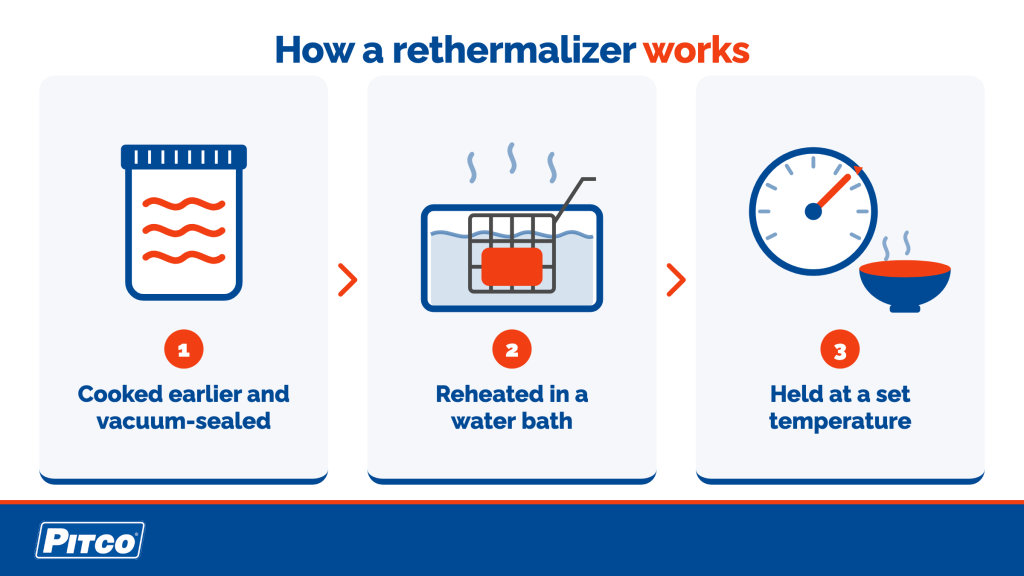
A rethermalizer takes previously cooked, vacuum-sealed food, reheats it in a water bath, and holds it at a set temperature.
How does a rethermalizer cut food waste?
Food waste is the other cost a rethermalizer helps control. When a kitchen cooks food ahead and keeps it in a holding cabinet or food warmer, the food stays fresh for only a certain period, and whatever doesn’t go out in that window costs you money.
A rethermalizer cuts that waste in two ways. It holds food at a precise, ready-to-eat temperature without the risk of overcooking or shrinking it, however long service runs. And because the food comes in frozen packages, you reheat only what you need and leave the rest in the freezer, so less food spoils or goes uneaten.
Which Pitco rethermalizer fits your kitchen?
Pitco makes its Solstice rethermalizers in three models. Which one fits depends on whether your kitchen runs on gas or electric and how much floor space you have.
Compare all three and request a quote on Pitco’s rethermalizer product page.
Commercial Rethermalizer FAQs
 What is the difference between a rethermalizer and sous vide?
The two look alike because both work with food in vacuum-sealed packaging, but they do different jobs. Sous vide cooks food in the vacuum-sealed package. A rethermalizer reheats previously cooked food, then holds it at a set temperature until service.
Can a holding cabinet do the same job as a rethermalizer?
Only for a limited time. A holding cabinet or food warmer keeps cooked food fresh for a certain period, while a rethermalizer holds vacuum-sealed food at a ready-to-eat temperature for as long as necessary, without the risk of overcooking or shrinking it. With a rethermalizer, you also reheat only what you need.
What foods can you rethermalize?
You can rethermalize anything from beef and poultry to pasta and soups. The food goes in already cooked and sealed in vacuum packages, so your crew only has to reheat it and hold it at a ready-to-eat temperature.
Should you choose a gas, electric, or countertop rethermalizer?
Start with your kitchen’s utilities and floor space. Pitco’s floor-standing rethermalizers come in gas (SRTG14) and electric (SRTE14). If floor space is tight, the CRTE is an electric countertop model with a 6-gallon tank.
Considering a rethermalizer for your kitchen? Schedule a free Water Cooker Consultation from Pitco to get started.

Topics
- Foods & Trends (91)
- Fryers (89)
- Oil (58)
- Fried Food (53)
- Filtration (33)
- See All Topics